More Science of Hibiscus Pigments
We all know that sunlight and heat affect hibiscus pigments. Strong light and heat make oranges, orangy-reds, and yellows much more vivid, since these colors all come from tough carotenoid pigments that protect flowers from sunburn. So the more sun, the more carotenoids the plant produces, and the brighter these flowers are. This is how 'White Hot' at right develops all these vivid colors and marking in the hottest part of the summer. In winter, it can be quite pale and plain, with very few markings.
In addition, white flowers or white markings on flowers need sun and heat because they come from delicate, soft yellow or soft pink flavonoid pigments that need to be burned off in order to turn parts of the flower pure white. If the weather is cool, these pigments won't burn off and they will show their soft yellow or pink colors. We've all seen this with white flowers. All of them have either soft yellow flavonoid pigments or soft pink ones. So in cool weather, our white flowers turn either pink or yellow, which is frustrating! But this is normal! Without heat and sun, the levels of flavonoid pigments increase, and the pigments last a much longer time. So the eye of 'White Hot' can be much more yellowish in cool, winter weather, but in high summer heat and full sun, it is a clear, brilliant white.
Blues, purples, soft pinks, and bluish-reds are the complete opposite though. They burn up and get very pale in high sun and heat. These colors get much, much darker and more vivid in cool shady places or during cooler times of the year. This is because these colors come from anthocyanins whose role is to protect the flowers from cold. They are like anti-freeze for flowers. When it is hot and sunny, they aren't needed and they just burn away quickly or never even develop. When it's cold and shady, the flower needs them, so they develop at high levels, and give these flowers their deepest, most vivid, long-lasting colors.
All of you who have been reading our newsletters for a few years probably already know most of this. But what has been more confusing is the role of pH, acidity versus alkalinity, on hibiscus pigments. Hibiscus can have so many different pigments in one flower that it is hard to figure out which pigment is doing what, and how the different pigments change each other. We do know that they do change each other, but that's as far as we go at this point. Flavonols influence anthocyanins, and change their colors, but nothing seems to be consistent. So this means there must be a other variables involved, such as different elements or molecules that are cofactors in the coloration process. It's all much more complex than we wish, and scientists still know very little about all of these interactions, because there are so many pigment variations and so many variables that influence each of these pigments.
So you can imagine our excitement when we found a new research study that pinpoints the exact effect of pH on one very specific hibiscus pigment: the red pigment of the mother of all our hibiscus, Hibiscus rosa-sinensis - the original species of tropical hibiscus that all our hybrids descended from.
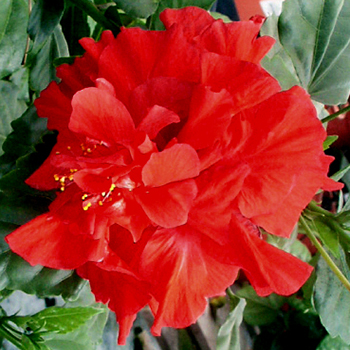
Hibiscus rosa-sinensis is red - always red! In any weather, in any amount of sun, the flower is red. The red can have a more bluish cast in cool weather, which tells us that it's an anthocyanin pigment. But it's a more durable anthocyanin than many others, and a very consistent one. It is one single anthocyanin, called cyanidin-3-sophoroside, which makes it much easier to study. There's no interplay between different pigments, there's just the one pigment. For this reason, it was being studied in Sri Lanka as a possible organic dye that could be safer for human consumption than the troublesome synthetic dyes that can cause health problems. This study was trying to find out if changing pH alone would change the color of the pigment, since anthocyanins are known to be so changeable, and pH is one thing that frequently changes them.
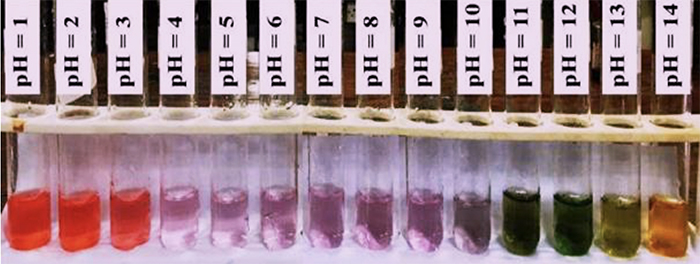
The results were somewhat predictable, but went far beyond what we expected! Look at the different colors that all came from the red pigment of Hibiscus rosa-sinensis:
The range of colors is amazing, and all just due to changing pH. At its most acidic, at the left-hand end, the pigment shows its normal red color. As pH rose, closer to the neutral level of 7, right through the 6.5 point where hibiscus plants thrive, it turned a lilac color. In our hibiscus, at this pH, the flowers stay red, so when the pigment is extracted and outside the flower, dissolved in a solution, the color stays red at a lower pH. In our plants, the pH would surely have to be around 8 or above for the red color to change to lavender, which would of course greatly stress the plant! But at even higher levels of alkalinity, in the test tubes from 11-13, the pigment extract turned green, and then at 14 it turned yellow! It shows the amazing changeability of anthocyanin pigments, and all the reasons our flowers can be so frustrating at times when the colors aren't what we think they should be! It's truly not us! It's the pigments themselves.
So what practical application does this have? Hmm . . . not so sure. This research does help explain why our blues sometimes get a weird, pale yellowish cast, and our reds can be a pale golden color at other times. It also demonstrates the importance of maintaining a good pH around 6.5 for all our hibiscus plants, the pH that they need in order to be their healthiest and best. This is the pH that native species hibiscus prefer, and this is the pH that all our flowers were hybridized for, so this will be the best pH for us to see maximum, expected colors in our flowers.
Future implications for flower development could be coming sometime in the future, especially as we get more research on pigments and their interactions. For now, we were just amazed and fascinated by what this research showed. We hope it's of fun and interesting for you too!
Seedling of the Month . . .
|
Our New Seedling in its Darker Colors
|
|

Our New Seedling in its Lighter Colors
|
|
|
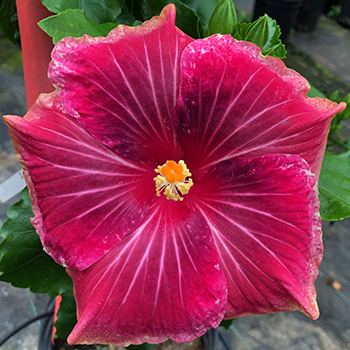
Our September Seedling of the Month first caught our eye when we passed by the original mother plant and it was constantly covered in flowers. Then we started to notice how different the flowers often looked, even on the same day, all on that one plant, and even in their opening colors. It was so fun to see what the flowers would look like each day, that this little seedling quickly became one of our favorites. As you can see from the photos above and below, the 6-8" single flowers bloom in rings of variable colors that can include fuchsia, soft pink, blue, white, and or soft yellow. This new seedling is a perfect example of the variability of anthocyanin pigments, as we wrote about in the article above! The edge is always a softer color, but the anthocyanin pigments can range from soft yellow to soft pink, or burn off to pure white. There can be a lot of blue with a softer pink body, or a vivid fuchsia body with a smaller dark blue shadow, and a soft pink edge. But the most fun thing is that all the looks are beautiful! We can't decide which look we like best, and we really love when there are 2-3 different looks on the same day.

Our New Seedling is an Amazing bloomer!
|
Our September Seedling looks a lot like its mother, multi-colored 'Tahitian Imperial Star.' But the seedling's anthocyanin pigments are deepened by the genes of its purple and white father 'Purple Rain.' The bush is upright, well branched, and a great bloomer! We hope you like it! If all goes well, we may have this new variety available for sale sometime in 2020.
|
|