Hibiscus Plant Care
Water Like a Pro!
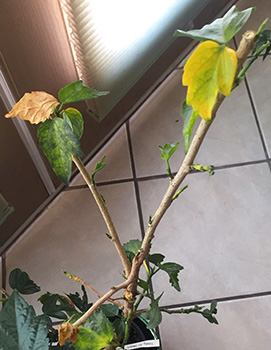
A dehydrated plant: Dry soil, yellow or brown
leaves that fall off and leave bare branches
|
When it comes to water, almost all living things on Earth have very similar needs and dangers. All humans and animals need a certain amount of water to live and stay healthy - a "just right" amount. Too little water will stress our bodies and slowly kill us with dehydration. Too much water will overwhelm us, drown us and kill us quickly. We need to be right down the middle with just the right amount of water.
Plants are exactly the same. Too little water and they shrivel up and die of dehydration. Too much water and the roots drown and die, killing the whole plant very quickly. We often call this "wilt disease" because even though the roots are soaking wet, they are dead or dying and unable to send water up to the green parts of the plant, so the green parts wilt and die quickly too. Sometimes too much water kills more slowly, stressing the roots. When this happens nasty microbes that hang around everywhere in soil, air and water, then attack the weakened plant, invade the roots, clog them up, and kill them slowly. By the time we see the wilted leaves, sadly, it's almost always too late.

A drowned plant: Wet soil, dark green
or dark brown leaves that wilt and
stay on the plant for some time
|
Humans and animals who are thirsty or drowning can make noise to complain, move, and go in search of water to drink, or a safe dry place to prevent drowning. Unfortunately, our plants are 100% at our mercy! They can't even communicate that they're in trouble until it's too late and catastrophic damage is done. It's all up to us! So the singlemost important thing any plant grower needs to learn is how to give each plant that "just right" amount of water. Where is that fine line and how do we learn to find it?
It sounds hard, but it's actually really easy if you follow a couple of small rules:
Rule 1: Always Moist Soil, Never Standing Water
Hibiscus, and almost all tropical plants, need soil that is always moist, but never with puddles or leftover standing water anywhere. If you let the plants dry out between waterings, they will be stressed and start dropping leaves and buds. If you leave puddles of water standing on top of the soil or in a saucer beneath the pot, you risk killing the plant quickly by drowning the roots or infecting them with predatory microbes. So to accomplish this rule, we need to:
Water until all the soil is moist,
then let all excess water drain completely away.
The easiest way to accomplish this with plants in pots is to not put a saucer under the pots and to let all excess water drain out onto the ground. This works great for many outside potted plants! Do this wherever you can because it is the safest possible way to water hibiscus. But unfortunately many of us grow hibiscus plants in our houses or in places where we can't let the water drain onto the flooring. We have to put saucers under our pots or we'll damage our houses! But standing water in saucers under plants is one of the biggest killers of potted plants. So for plants that need saucers, we need another rule:
Rule 2: Leave no Standing Water in Saucers under Pots
It's very difficult to thoroughly moisten the soil in a pot without having excess water go into the saucer beneath the pot, and it's not even necessary to try. If the soil has dried out at all, you will need to really wet it with plenty of water, and the excess will inevitably drain into the saucer. But if you walk away and come back in 1-2 hours, some or all of that water will have absorbed back up into the soil, which is what we want. The extra water is wicking back up and finishing the job of fully moistening the soil. So all we need to do is:
Check the saucer beneath each plant 1-2 hours after watering,
and pour all leftover water away.
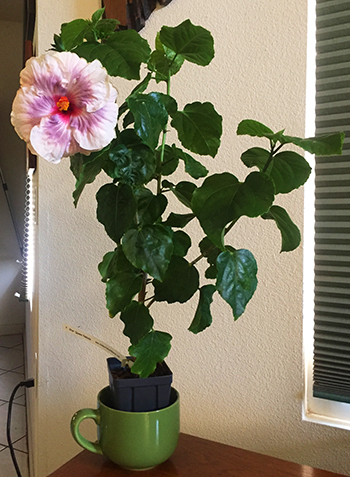
A 9-month-old healthy hibiscus in a 4" pot,
glossy dark green leaves, already blooming.
The coffee mug makes it easy to dump any
excess water and make sure the plant has
optimum water levels at all times. As a
houseplant, it will stay in this pot for
1-2 more years, then go in a 6" pot for life.
|
Over time, you will learn how to water each of your plants so that you moisten the soil without leaving excess water in the saucer. It's both an art and a science, and once you know that this is your goal, and you get to know each of your plants, you'll find your own little system to decide how much water to give them in your climate and in each season. Cindy has been growing hundreds of tropical houseplants all her life, and killed many of them for the first 5-10 years. It was all about watering! In desperation one day, she finally started using a 1/4 cup measuring cup and counted and kept records on how many of these little quarter cups she gave each plant to fully moisten the soil and leave no excess in the saucers. Small, non-root-bound plants only needed one every day. Large root-bound plants needed 3-4 every day. Over time, she learned to judge these measurements without the little measuring cup, and was able to water them all intuitively. But even now, with a new plant, especially with sick plants, she still pulls out the old 1/4 cup measuring cup! When in doubt, it never hurts to start by measuring and counting. Nothing hones your skills like a little bit of a scientific approach.
How often to water depends on the weather and where your plants are growing, but generally the more frequently you water, the more evenly moist and happy your plants will be. In summer plants will need watering 1-2 times per day outside and every 1-2 days inside a house. In winter, watering can be as little as two times per week - or even less if your pots are outside in a rainy climate. Remember, the key is a little bit of water frequently is better than a lot of water infrequently, because our goal is evenly moist soil at all times. No drier times and wetter times! As evenly moist as possible at all times is the key.
We're almost there! You're almost a pro! But we have to think about one more thing. No matter how carefully you water, your plant will still suffer from watering problems if it's in the wrong size pot! If the small plant above were transplanted into a large 8-10" pot, it would not be possible to prevent overwatering simply because there would be too much moist soil for this small plant to use. One of the most common causes of overwatering is transplanting too early into a pot that is too big. There is a very dangerous myth out there that transplanting and giving plants a lot of fresh soil is like a tonic that boosts the health of the plant! WRONG!!!!!!!!! This is frequently a lethal mistake! Plants like to feel cozy and protected in their pots. A giant pot full of unknown predatory microbes is a danger zone. Even if you use sterilized soil, it takes almost no time for microbes to start growing in the pot, just from exposure to air and water. So for our next rule:
Rule 3: Be Very Slow to Transplant, and Transplant Carefully!
Transplanting is its own topic, but it ALWAYS affects watering. A healthy plant can quickly die of overwatering just from bad transplanting, so we need some transplanting rules to prevent this.
Don't transplant until your hibiscus is so root-bound that you're starting to see roots grow out the bottom, and your plant is constantly falling over in its heavy pot.
Even then wait until warming spring weather to transplant. Never transplant at a cold, cloudy, rainy time of year unless you have a very warm house with very sunny windows for your plant. Plants need increasing sun and warmth to pull through the stress of transplanting and to quickly start filling up a new pot with their roots. So if you don't have conditions of increasing warmth and sun, wait for warming weather!
Pot up one only small pot size, with only one extra inch on each side of the new pot.
Go from a 4" pot to a 6" pot. Most hibiscus can stay in a 4" pot for 2-3 years easily and then indefinitely in a 6" pot, especially if you root prune every few years. If you eventually want your hibiscus to go into a bigger pot, then very gradually pot up one more pot size every couple of years until you reach the pot the size you want. If you rush it, you risk either stressing or killing your plant.
Transplant gently and carefully, trying not to disturb the roots at all.
Ripping roots during transplanting is another serious problem that makes many plants quickly wilt and die. People think it's "transplant shock," but a fast death after transplanting is much more frequently caused by roots that are ripped away from the main stalk of the plant, or roots that have been torn apart by fingers and are so damaged that they can't send water up into the plant.
Never prune at the same time as you transplant!
When you put a hibiscus into a bigger pot, you need the full top growth to suck up water quickly, to keep everything moving through the plant, and to photosynthesize heavily to create food for the new growing roots as fast as possible.
Now You Can Water like a Pro!

Hibiscus houseplants blooming in a sunny kitchen in winter.
From left to right: Krakatoa, Floral Bliss, Rags to Riches
|
Knowledge is power, and now you have it! If you follow these rules, your hibiscus watering program will work like magic. Your hibiscus will thrive, bloom, and have lots of green, healthy leaves at all times! Your thumb will become greener and greener, and you'll be amazed at how easy it all is.
Seedling of the Month . . .
|
|
|
|
|
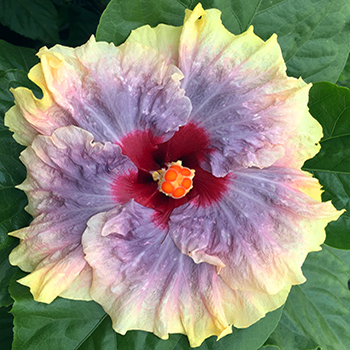
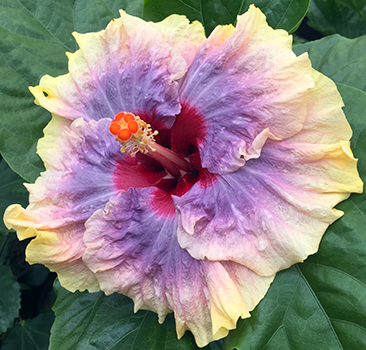
This new, unnamed seedling is a perfect ruffly beauty with its blended rings of yellow, white, pink and blue around a bright red eye. We love the contrast between the soft, blended, ruffly rings around the sharp, rather geometric eye. It's hard to develop new and unusual flowers after so many years of hybridizing, but this one definitely fits its own new little niche. Our new seedling's mother is blue and white tried and true variety, 'Fire and Ice.' Its father is soft blue and pink, 'Blue Opal.' The bush is full and lush with large leaves. We hope to have this one available for sale sometime in 2022. We hope you like it as much as we do!
|
|