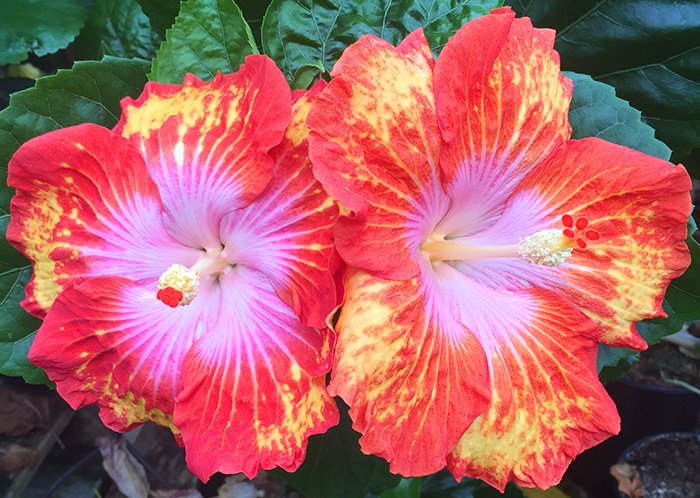
Our new 2008 Online Store is now open with 130 hibiscus varieties, including 14 new varieties, along with all the care products your hibiscus could need to stay happy and healthy. For the best selection of the year, order now to reserve your hibiscus for shipping in the spring. Happy shopping!
"Just HAD to let you know - the plants arrived today... someone had to wake me up, because I SWOONED... they are so beautiful! Thank you so much for your care, the awesome blooming hibiscus and the amazing customer service on my request and in RECORD time. Please know that I am now a customer and fan forever. Thank you" Diane D
"Thank you so much. I received the plants last week and they are gorgeous. I just placed an order for two more plants. Again, thank you for the beauties." Sheila J
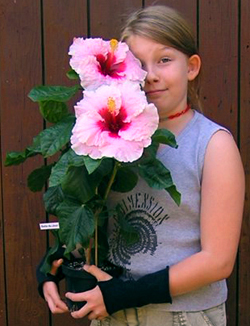
Diane and Sheila are just a few of the many happy HVH customers. Read more customer comments here! The photo above shows the typical size of plants in 6" pots (this is cultivar 'Belle du Jour') at the time of shipping, although size varies by cultivar and we don't guarantee the open blooms. See Terms & Conditions for more information on our guarantees and shipping policy.
Expert Advice... by Charles Black
Charles Black answers hibiscus questions. Charles is a world renowned hybridizer and grower of exotic hibiscus, as well as the owner of Hidden Valley Hibiscus. He has created many award winning hibiscus varieties, such as Heaven Scent, Her Majesty, Simple Pleasures, and Love Story. In this column, he shares his expertise in growing hibiscus with our visitors. Enjoy!
 
Hibiscus Wilt Disease
My Hibiscus Leaves are all Green, but Wilting and Dying! What Should I do?
Most hibiscus pests and diseases are not fatal and can be easily cured, but hibiscus wilt disease is one that can be scary, because it can kill an entire plant in an amazingly short time.
What Causes Hibiscus Wilt Disease?
Healthy Hibiscus Leaves Stand Out Crisply
Hibiscus wilt disease is no different from wilts that affect many ornamental plants. It is caused by fungi with such intimidating names as Fusarium oxysporum and Verticillium. This disease is often referred to as "root rot" but that is a misunderstanding of the problem. What is actually happening is that pathogenic fungi are rapidly reproducing in the soil mix of the pot and entering the plant through the roots. The roots of infected plants do not
show any "rot" except possibly in the late stages of the disease - if the plant survives that long. Once inside the hibiscus, the fungi disrupt the plant's capillary system, preventing water and nutrients from circulating normally.
How do I Know my Hibiscus has Wilt Disease?
Although the leaves slowly wilt and die in wilt disease, they usually do not turn yellow, which makes wilt disease an easy problem to spot. Almost all other hibiscus problems cause the leaves to turn yellow. But with wilt disease, the leaves will tend to stay the green they were to begin with, or they may slowly darken as they wilt to a dark green, brown, or blackish color. Wilt disease will also hit the entire plant, not just one tip or branch. If just one tip or branch is wilted, then your plant has dieback disease, which can be cured but pruning away the damaged branch (more about this next month), but not the dreaded wilt disease. For wilt disease, look for wilting green leaves all over your plant, or all over one entire side of your plant.
Wilted Green Leaves ~ Hibiscus Wilt Disease
As soon as you see wilted green leaves covering your hibiscus, feel the soil at the base of the plant. Is it wet or dry? If it is very dry, the wilt may just be caused by drought or underwatering. A quick dose of water will solve this problem! But if the soil is damp, and especially if it is wet, then wilted green leaves almost always spell wilt disease, and it is very important that you act quickly! Wilt disease can overcome and kill an entire large plant in a week or two - sometimes even more quickly than that.
Prevention ~ The Best Cure!
If none of your plants have wilt disease, then learn how to prevent it now! Prevention is by far the easiest and best cure for wilt disease, and it's an important part of keeping hibiscus healthy. Wilt disease is by far the most common cause of hibiscus loss - we get email several times a year from heartbroken hibiscus lovers whose plant is dying of wilt disease. Just the time it takes to send and receive an email can be long enough for the disease to kill the plant, so learning to prevent wilt disease in the first place is clearly the wisest course of action.
Follow these steps to help keep your hibiscus free of wilt disease:
Do not overwater! Adjust watering to match the season and the weather. In summer hibiscus need frequent watering, often daily, but in cooler times they need much less water. Fungi love soggy, wet soil, and if you keep your hibiscus too wet, you are inviting fungi to grow there. Most wilt disease strikes in winter when gardeners fail to reduce watering enough and the soil stays too wet and cool.
Keep your pots clean. Remove dead leaves and flowers from both the plant and the pot.
Control insects, as they can spread disease and make wounds in the plant that pathogens can enter.
When transplanting, try not to wound the plant, as such wounds are entry points for pathogens.
Do not overfertilize or fertilize when the soil mix is dry, as this can burn the roots and make the plant more vulnerable to attack.
Use a growth enhancer on a regular schedule to help keep hibiscus immune systems strong enough to fight off wilt disease in the initial stages. This new preventative treatment is looking very promising.
Apply worm castings to the surface of the potting mix, working it into the mix as best you can. Start with a layer that is 1/2" - 1" of castings on the surface of the potting mix. Or mix it into the potting mix before potting up, using about 1 part castings to 5 parts potting soil. This has reduced our problems with wilt of young transplants at HVH to almost zero. (If you use HVH Potting Mix, it comes pre-mixed with worm castings.)
Apply Rootshield/Plantshield beneficial fungi according to label directions. This material is similar to the worm castings but perhaps more potent and targeted to disease problems.
Optional, but recommended for those with continuing disease problems: in Fall and again in Spring drench your pots with fungicides. Use Phyton (copper based) or any product containing thiophanate methyl, such as Cleary's 3336, Domain, Medallion, or Fungo, or any other fungicide recommended by your local agriculture extension office. It will help to remove or suppress fungi. (Although Subdue Maxx is recommended by some, we do not recommend it, as it is specific only for other types of fungi that do not usually cause wilt disease in hibiscus.)
Help! I Already Have Wilt Disease! What do I do?
First Signs of Recovery ~ New Tiny Growing Tips
Act quickly! Do not wait to see if the plant gets better. Wilt disease kills quickly, and plants almost never recover on their own. Immediately try one or more of the following for an emergency save:
The classic emergency save is to mix 1 pint of household bleach with 2 quarts of warm water. Pour this solution into the pot with the wilted plant, saturating all of the potting mix. This will kill off the fungi growing in the mix but will not affect the fungi already in the plant. Sometimes the plant recovers after this, sometimes not.
As an alternative to the bleach, use the same fungicides recommended above as a drench in the potting mix.
Sometimes a rescue can be achieved by removing the wilted plant from the pot, removing as much soil as possible from the roots, and then
washing the roots with clean water. Afterwards repot in fresh clean soil mix that is moist but not sopping wet.
Our newest emergency save is to use a very strong dose of a growth enhancer/stress reducer to help the plant's own immune system fight off the infection in all parts of the plant. Our preliminary results with this treatment have been successful, although we have not tried it enough to be certain of its success rate. It has worked well in the early stages of wilt disease. For this treatment, pour 1 teaspoon of undiluted growth enhancer carefully into the soil at right at the base of the plant. Add 2 teaspoons of water to wash the growth enhancer into the roots. Do not use more water or growth enhancer than this! Wait a week and repeat application. If the plant survives, repeat weekly until you see new, healthy growth emerge. Then continue to dose with normal, diluted doses of growth enhancer until the new growth is fully grown and the plant is strong and healthy again. (This is the technique Cindy now uses on HVH's sick plants.)
Full Recovery from Wilt Disease ~ Lots of Healthy New Growth
While the plant is recovering, keep it in the shade and do not water it any more than you absolutely have to. Use one or more of the following to help the plant recover, applying them with as little water as possible until the plant is fully leafed out again:
Growth enhancers are the product we recommend most highly for any sick plant now.
Plantshield/Rootshield will help beneficial and protective fungi colonize the roots again. This is especially important if you used a bleach treatment that kills all fungi, both bad and good.
A transplant shock treatment containing B vitamins will also help pull the plant out of its illness. Superthrive is our favorite.
New tiny growing tips will appear within a week or two if the plant is recovering. If no new growing tips appear within about 3 weeks, try scratching the bark of the main stem to see if there is green underneath. If there is green underneath, continue treating the plant. If not, then the plant has died and should be disposed of off the property. Wrap it in a plastic bag and dispose of it in the trash. You do not want to spread this disease to other plants!
Wilt is a serious plant disease. Prevention is better than cure as many plants will perish once they have it no matter what type of "cure" is tried.
This is the second time this year that we have featured growth enhancers - for a very good reason! At HVH, growth enhancers have become our first line of defense and offense against every kind of hibiscus stress or disease. We use them on our baby plants as a preventative to keep them strong and healthy, and to help them fight off any microbes in the air, water, or soil, as well as to help them bounce through any kind of external stress. Growth enhancers have become the first thing we use for any plant that has been stressed by disease, flooding, drought, too much cold, or too much heat. It seems hard to believe that one product type could do all of this, and we hesitated to rave about these new products too much when we introduced our first growth enhancer after seeing only preliminary results. But after a year of use now, we HAVE to rave about them! Growth enhancers are the most amazing new products we have found in the last few years, and we feel like we finally have something that can help us pull our hibiscus through almost anything.
Growth enhancers can't work miracles, of course. If a plant is dead, it is dead, and nothing can bring it back. But if your hibiscus looks like a dead stick with no leaves, and you scrape a bit of bark off with your fingernail and see green underneath, then it is not dead! This is when growth enhancers can work wonders. If you are raising hibiscus in a difficult situation, like not quite enough sun, or too much hot sun all summer, or inside a house, or in less-than-optimum soil, you can use growth enhancers regularly to keep your plants feeling strong and healthy and prevent them from slowly going downhill.
The science behind growth enhancers is solid, and works on several different levels. You can read this science on our website on the page about growth enhancers if you are interested. Growth enhancers are rather expensive (for us too!), but the vigor, strength, and health they give our plants makes it an absolutely necessary addition to the care products we use on our plants here at HVH. You may want to consider them too!
The growth enhancer we sold formerly was called Synergy, and we have now replaced it with a new one called Super Nova. They are nearly identical in composition, and the cost is exactly the same, but Super Nova is more concentrated, so you use less of it, and a quart container will provide more treatments. We appreciated this savings with our use in the greenhouse, and wanted to pass it on to our customers too.
Bring out the best in your hibiscus with our HVH Special-Blend Fertilizer. It is especially formulated to meet the needs of hibiscus, with extra potassium to produce more, bigger, and brighter-colored flowers, as well as an array of trace nutrients to build stronger, healthier bushes. It's a special blend we developed here at HVH for our own hibiscus growing in our greenhouses. So many customers asked for it that we have been selling it for several years now. Click here for more information.